Reversals

The thirteen reversals

Thirteen places where copying baseball's answer into a fastpitch dugout will cost you games. These are not differences of degree. They are the places the conclusion flips.

Structural follows from the rules or the dimensions of the sport — not an opinion and not a measurement, a consequence. Measured is grounded in published data for at least one of the two sports. Reasoned means the direction is well supported and the magnitude is constructed. Six of the thirteen are structural, two are measured, five are reasoned.
01

The plane of attack★Structural

Baseball

The decisive edges are horizontal. Pitchers work in and out; hitters cover the width of the plate and treat depth as the adjustment.

Fastpitch

The decisive edges are vertical. The riseball and the drop split the zone top to bottom, and the width of the plate is the second problem.

Why it flips. An underhand delivery puts the ball on an upward path with spin applied in a vertical plane. A 12-inch ball from 43 feet has less time to move laterally and more usable separation up and down. A hitter tracking the ball side to side is solving the other sport’s problem.

02

Which way to miss★Measured

Baseball

Miss down and away. The chase that produces the most harmless swings sits below the zone and off the outer edge.

Fastpitch

Miss up. The ring above the zone is the most forgiving place a pitch can finish, and a riseball above the letters is the highest-chase pitch in the sport.

Why it flips. A pitch leaving the zone upward stays inside the hitter’s visual window the whole way; one leaving downward exits it early. Baseball’s low chase works because gravity confirms the miss. Fastpitch’s high chase works because nothing does.

03

Two strikes cost less★Measured

Baseball

An 0-2 count is close to an out: .171 league average from there, and a strikeout rate near 44%.

Fastpitch

Two strikes is a worse count, not a lost one. Division I strikeout rates run 15 to 17% against baseball’s 22%.

Why it flips. Fewer strikeouts means more two-strike plate appearances end in play. Contact hitting with two strikes is a plan with a payoff rather than a hope. The table below has the full comparison.

04

The cost of an out goes up★Reasoned

Baseball

Around 4.4 runs per team per game. An out is expensive, and the sacrifice still has defenders in specific base-out states.

Fastpitch

A richer run environment. Every out you hand over costs more than the same out costs in baseball.

Why it flips. Run expectancy scales with the environment. The more runs an inning is likely to produce, the more a voluntarily surrendered out subtracts. The sacrifice is harder to justify in fastpitch than in baseball — which inverts the sport’s own folklore.

05

The bunt is a weapon, not a concessionStructural

Baseball

A bunt is a sacrifice. You trade an out for a base, and the only question is whether the trade is worth it.

Fastpitch

A bunt is a base hit attempt. The question is whether you beat it out.

Why it flips. Sixty-foot basepaths, corners who must honor the slap, and a runner who may already be moving push the bunt hit rate high enough that it stops being a trade. This does not contradict #4 — it resolves it. Bunt to reach. Never to give up the out.

06

The left side of the box is a different positionStructural

Baseball

Handedness is a platoon question. A left-handed hitter stands where she stands and the matchup is the story.

Fastpitch

A left-handed hitter can take a running start. The slap converts foot speed directly into on-base, and it has no baseball equivalent.

Why it flips. The rules permit forward motion in the box before contact. That single allowance creates an offensive role that has to be scouted, defended and developed on its own terms. Evaluating a left-handed fastpitch hitter through baseball’s platoon framework misses the entire point of her.

07

Do not elevateReasoned

Baseball

Launch angle. The ground ball is the least productive outcome, and a decade of work has gone into hitting fewer of them.

Fastpitch

A hard ground ball is a live and productive outcome — often the better one.

Why it flips. Short basepaths, infielders pulled in to defend bunt and slap, and a heavier ball that carries less all push value back toward the ground. The fly-ball revolution was an answer to baseball’s run environment and baseball’s fences. Importing it wholesale costs fastpitch teams hits they would otherwise have.

08

The ace is not a resource to rationStructural

Baseball

Pitch counts, innings limits and five days of rest are the governing constraints. Protecting the arm comes first.

Fastpitch

One pitcher can carry a tournament. Usage is bounded by effectiveness and recovery, not by a count convention.

Why it flips. The underhand motion loads the arm differently, and the sport never developed baseball’s pitch-count norms. Read that carefully: the absence of a convention is not the absence of a limit, and workload still matters. But a coach running a fastpitch staff on baseball’s rationing instincts leaves her best pitcher on the bench in games she should be finishing.

09

The third time through does not bite the same wayReasoned

Baseball

Production climbs measurably each time through the order. It is one of the better-established findings in the sport and it drives modern bullpen use.

Fastpitch

The penalty is weaker, and the replacement is usually worse.

Why it flips. Baseball’s penalty is part familiarity and part velocity decay, and it is cashed in by a bullpen built to exploit it. Fastpitch rosters rarely carry that depth, and movement-first pitching decays differently from velocity-first pitching. Pulling an effective starter in the fifth because baseball says so trades a known quantity for a worse one.

10

Infield depth: in is the defaultStructural

Baseball

Standard depth is back. You move in for specific situations and accept the cost of doing it.

Fastpitch

Corners start in. Moving back is the exception that needs a reason.

Why it flips. With 60-foot basepaths the throw beats the runner only if it starts close, and the bunt and slap threats are constant rather than situational. Baseball’s default depth concedes exactly the plays fastpitch offenses are built to run.

11

Stealing is about the release, not the leadStructural

Baseball

The lead is the asset. The running game is built on the secondary lead, the pitcher’s time to the plate, and the jump.

Fastpitch

There is no lead. The runner holds the base until the ball leaves the hand, so the whole steal lives in the release and the pitch called.

Why it flips. Illegal leadoffs delete the largest single input to baseball’s steal model. What remains is timing on release and pitch selection — a rise at the top of the zone is a different steal than a drop in the dirt. Scouting a fastpitch runner for her lead is scouting something the rules do not let her have.

12

Sequencing runs a vertical ladderReasoned

Baseball

Sequences work off the fastball and move side to side. Changing eye level is a secondary tool.

Fastpitch

The ladder is the sequence. Drop to rise, rise to drop, and the changeup plays off the rise rather than off the fastball.

Why it flips. This is the working consequence of #1. When the separation that matters is vertical, the pitch that sets up the next one sits above or below it, not inside or outside it. A catcher calling a fastpitch game on in-out logic is throwing away her best sequence.

13

Catcher value sits in blocking and the throwReasoned

Baseball

Framing is the largest single defensive run contribution a catcher makes.

Fastpitch

Blocking and the throw dominate. Framing value is compressed.

Why it flips. A rise and a drop arrive at the edges of the zone on steep paths, which thins out the borderline-pitch population framing acts on — and puts far more balls in the dirt in front of runners who need only 60 feet. This is the least settled of the thirteen: no fastpitch framing study exists at the scale of baseball’s. The direction is defensible. The magnitude is not established.

Reversal 3, in numbers

MeasureBaseballFastpitch
Batting average with two strikes.171.200 - .230*
Strikeout rate22.2%15 - 17%*
Two-strike leverage index (0-2)-0.74-0.53*
Two-strike ball-in-play targetover 60% of PAover 65% of PA
Swing LENGTH with two strikesShorten it — same in both sports
Swing SPEED with two strikesDo NOT reduce it — same in both sports

* Fastpitch figures are estimates for NCAA Division I, or constructed from the baseball research. See Method.

Relative cost of a two-strike count vs baseball: roughly 25-30% LOWER
What that means in practice: Contact hitting with two strikes pays off more in softball

Spread the word

Right-click to save. Print them, post them, put them on a shirt. Each one is a reversal you can argue from.

Where baseball’s answer is the wrong answer
Miss upNo lead. No problem.Bunt to reach
43 feet
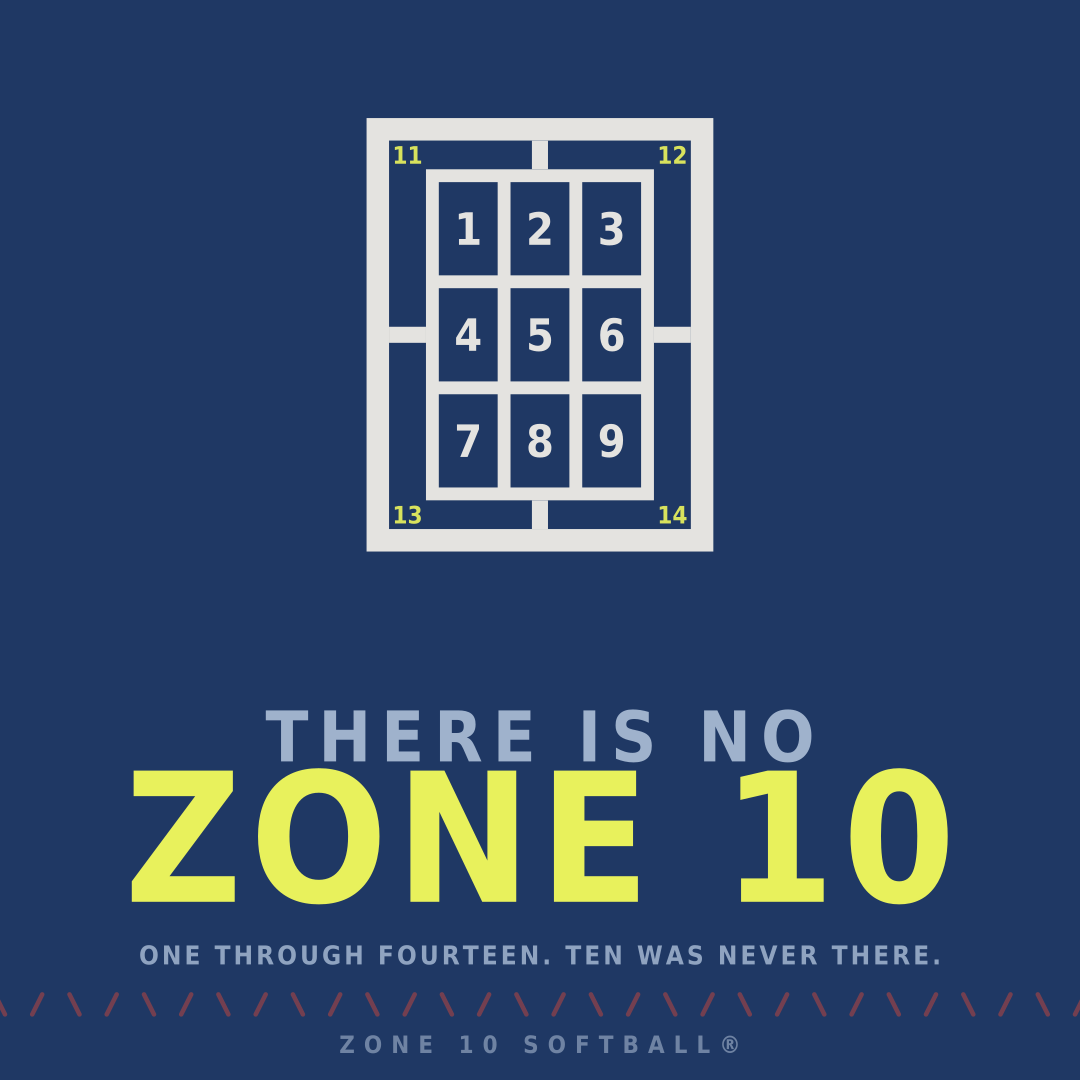
There is no zone 10
A star marks the four with the widest practical margin — the ones worth changing first if you change nothing else. Where a number is derived rather than measured, the tag says so. No published fastpitch equivalent of the major-league research exists; the direction of every read here is well supported, and the decimals are a construction.